 Abu Simbel Egypt Tours
Home › Guides › Abu Simbel Relocation: How and Why Were the Temples Moved?
Abu Simbel Relocation: How and Why Were the Temples Moved?
The Abu Simbel relocation did not build a copy. Engineers cut the original temples into 1,036 blocks and rebuilt them 65 m higher and about 200 m further inland between 1964 and 1968. If you plan to visit Abu Simbel, every part of the site you walk through is the moved one.
Quick answer The short answer on how and why Abu Simbel was moved
Abu Simbel was cut into 1,036 blocks and rebuilt 65 m higher and about 200 m further inland between 1964 and 1968. The Aswan High Dam would have flooded the original site under Lake Nasser. Egypt and 48 other countries shared the cost.
Key takeaways
- The temples you visit today are the original stone, so a trip is worth it: see the abu simbel tours that leave from Aswan.
- The sun still reaches the inner sanctuary on 22 February and 22 October, so those two dates are the busiest and carry the higher ticket.
- A shared day trip costs $40 per person on the Aswan hotel-pickup day trip.
- A private car and guide costs $128 per person on the private guide and car day tour.
Is Abu Simbel relocated?
Yes, both temples were moved, and the original rock they were carved from now lies under Lake Nasser water.
A common belief says the temples you see are a replica. They are not. The stone is the original sandstone, cut out and put back piece by piece. More history is on Abu Simbel facts, and the second temple on Temple of Nefertari.
Moved, not copied
Egypt's tourism ministry says the temples were moved in 1968 because the Aswan High Dam threatened to submerge them. An international effort led by UNESCO completed the work.
The Great Temple was cut into 807 blocks and the Small Temple into 235. Workers numbered each block so it could go back in the right place. The temples now stand on higher ground, with an artificial hill built over them.
The original site is now under the water of Lake Nasser. Nothing of the old setting can be visited.
What was kept and what was added
The carved rock faces, the statues and the interior scenes are the ancient stone. What is new is the support behind them. Domes were built over the temples and the hill covers them.
If you want to see the temples in context, the abu simbel tours from Aswan give you the full site in one day.
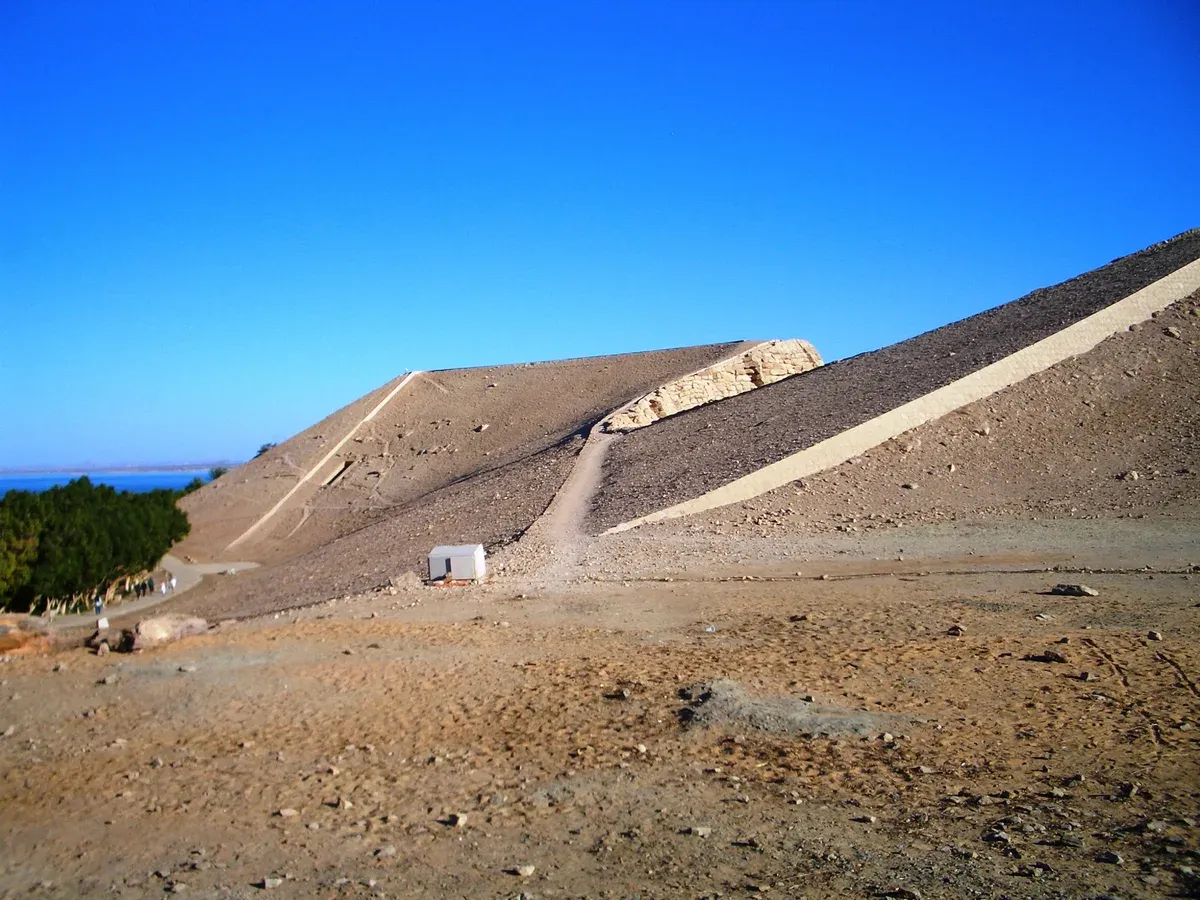
The man-made dome built behind the temples when they were moved. Photo: Peyerk, Public domain, via Wikimedia Commons
Why was the Abu Simbel Temple relocated during the 1960s?
The Aswan High Dam would have raised the water at Abu Simbel by up to 60 m and drowned the temples.
Ramesses II had the Great Temple cut into the living rock around 1264 BC. Three thousand years later, a new dam put it in the path of a lake.
The dam and the lake
The Aswan High Dam was built in the 1960s and threatened the Nubian monuments with submersion. The lake behind it, Lake Nasser, covers 5,250 sq km and did not exist 50 years earlier.
At Abu Simbel the water would have risen by up to 60 m. Water would also have weakened the sandstone, so the temple would have been at risk even above the waterline.
The rescue call
Egypt and Sudan asked UNESCO for help in 1959. Fundraising began in 1960. The International Campaign to save the Nubian monuments then ran from 1960 to 1980 and moved more than 20 other sites.
The Abu Simbel rescue was UNESCO's first collaborative international rescue effort.
Which plans to save Abu Simbel were rejected?
Engineers rejected a dam, barges and a lift, and chose cutting the temples into blocks because it was the cheaper plan.
Several schemes were studied before Egypt chose to cut the temples apart. The cheapest and simplest on paper won.
The schemes that lost
Wikipedia lists the shortlisted ideas. They included a filtered-water dam with observation galleries, concrete barges, a curved dam by Coyne et Bellier and a lift on a concrete platform by Italconsult.
The Swedish firm VBB proposed cutting the temples out of the cliff. Egypt adopted that plan in early June 1963. JSTOR Daily says it was chosen because it was much cheaper.
| Plan | Outcome |
|---|---|
| Curved dam by Coyne et Bellier | Rejected |
| Lift on a concrete platform (Italconsult) | Rejected |
| Filtered-water dam with galleries | Rejected |
| Cutting into blocks (VBB) | Adopted |
Tours That Fit
Both leave from Aswan and give you time at the moved temples.
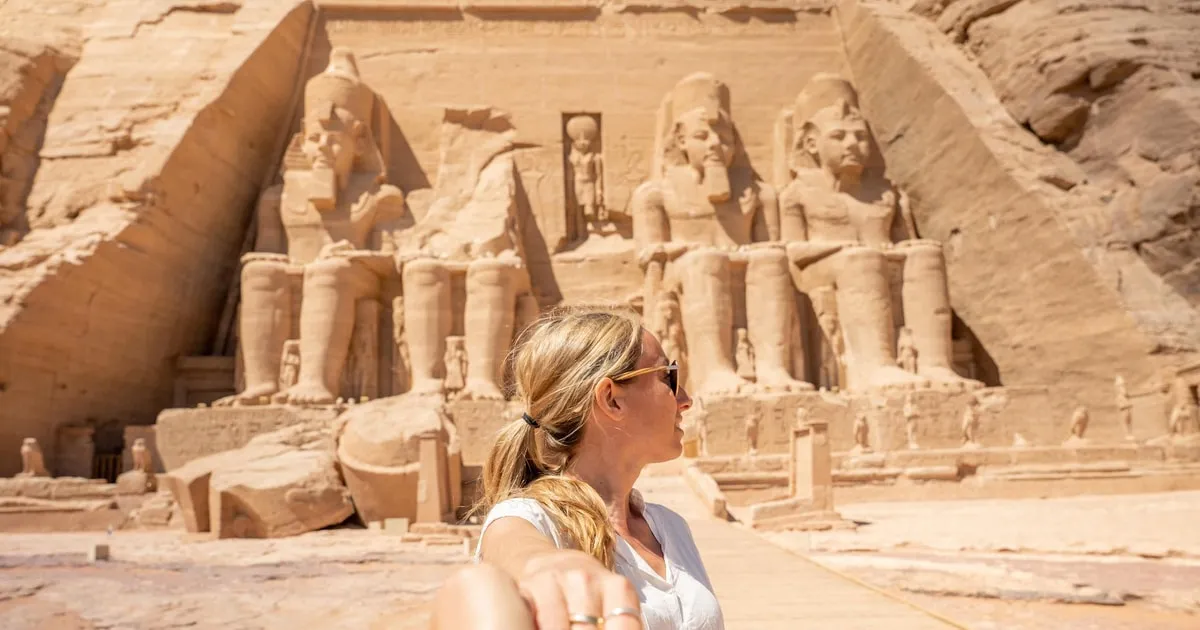 from $40
Most reviewed
From Aswan: Abu Simbel Temple Day Trip with Hotel Pickup
Cheapest bus seat to Abu Simbel at $40, with the entry ticket and guide as separate add-ons.
Check Availability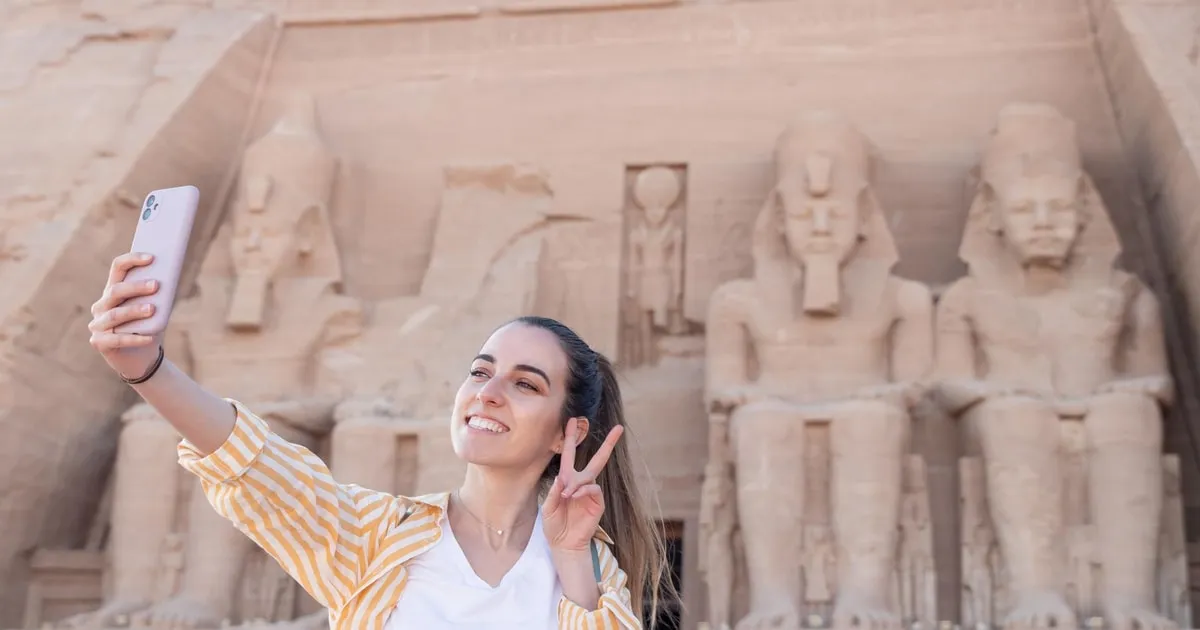 from $128
Private car
From Aswan: Abu Simbel Day Tour with Private Guide and Car
Private car and guide with the entry ticket in the includes list, at $128 per person.
Check AvailabilityHow did they move the temple of Abu Simbel?
Workers built a cofferdam, cut each temple into numbered blocks and rebuilt them on higher ground.
The method was slow and exact. Every block was cut, lifted, stored and put back by number.
Step by step
A joint venture led by Hochtief, with Impregilo, Skanska and others, did the work. About 1,000 people were employed by spring 1964.
First, a temporary cofferdam 25 m high (later raised to 27 m) and 370 m long kept the lake out. It used 25 pumps. Bulldozers then removed the rock above the roofs.
Handsaws cut the blocks because the sandstone is porous. Plastic epoxy was injected to stop it crumbling. The blocks weighed 20-30 tons each, and the smallest weighed 7 tons.
The first block was lifted on 21 May 1965 and the last on 16 April 1966. Disassembly had begun in November 1963.
Putting it back
The blocks were rebuilt inside new domes. Mortar was made with Nubian sand. An artificial hill of 300,000 tons covers the domes. Atlas Copco gives the stone above the cupolas as 330,000 cubic metres, so figures differ by source.
Workers kept the tolerance to plus or minus 5 mm. One temporary storage area later became the site of Abu Simbel Airport.
How far did they move Abu Simbel?
The Great Temple moved 208 m further inland and 65 m higher.
Every source agrees on the height. The inland distance is given as 208 m by Wikipedia and about 200 m by Atlas Copco.
The figures side by side
The Small Temple was lifted slightly more, to 67 m above its old level. The BBC says they stand more than 60 m above their original location.
| Measure | Great Temple | Small Temple |
|---|---|---|
| Blocks | 807 | 235 |
| Moved higher by | 65 m | 67 m |
| Moved inland by | 208 m | Ask the operator |
| Tolerance | Plus or minus 5 mm | Plus or minus 5 mm |
Before and after
The old setting is now under Lake Nasser water. Today the temples stand on higher ground inside an artificial hill. The measurements were recalculated so the sun alignment on 22 February and 22 October still works.
How much did the Abu Simbel relocation cost and who paid?
Egypt paid about half and 48 other countries paid the rest through the UNESCO appeal.
The bill came in about 10% over the estimate. The work finished 18 months ahead of schedule.
Who paid what
Financing was agreed on 14 June 1963. Egypt paid about half of the cost, UNESCO members and the United States the rest. JSTOR Daily adds that the United States could pay in part because it held Egyptian pounds from Food for Peace sales, and the workforce was paid in them.
| Item | Figure |
|---|---|
| Egypt's share | Half |
| Other countries | 48 countries, half |
| Overrun | About 10% |
Source: Sound and Light Egypt.
Does the sun still reach the sanctuary after the move?
Yes, the sun reaches the sanctuary on 22 February and 22 October, as the team confirmed on 22 Feb 1966.
Workers recalculated the measurements to keep the alignment. The check on the new site showed the sun reached 63.1 m into the temple and Ptah stayed dark.
What to expect on the two dates
On those two dates the sun's rays enter the temple, cross the main hall and light the innermost statues. Ptah, the god of darkness, stays in shadow. Atlas Copco gives the depth as 60 m, Wikipedia as 63.1 m.
The ministry charges a higher ticket on both dates. A foreign adult pays EGP 1,200 and a student EGP 600, against EGP 750 and EGP 375 on other days. Plan an early arrival.
Which tour to pick
The shared Aswan day trip costs $40 per person. It covers transport, and the entrance ticket and an English-speaking guide are included only if you select those options. Pickup is early morning, with the exact time on the voucher.
The private guide and car day tour costs $128 per person and includes the entrance ticket, a private English guide and a car. The supplier confirms the pickup time the day before.
What can you see of the relocation when you visit?
You see the hill behind the temples, the joins in the stone and the lake that replaced the old river view.
The move is part of the visit. Knowing what to look for turns a short stop into a better one.
On the ground
The temples are open every day from 06:00 to 17:00. A foreign adult pays EGP 750 on ordinary days.
Behind the facades the rock is an artificial hill covering the domes. Look at the stone for the lines where blocks meet. The Great Temple has four seated colossi and one collapsed in an ancient earthquake, with its pieces still at its feet. That was ancient damage and not part of the move.
The Small Temple to the north is dedicated to Hathor and Queen Nefertari. It was moved as well, in 235 blocks.
Evening and day plan
The Sound and Light show is listed at 19:00 and 20:00 each day. Show dates are subject to change.
Abu Simbel is about 300 km south of Aswan on the ministry's figure. The day trips listed here take 10 hours, so the abu simbel tours list is the place to compare them.
Sources: Egypt Tourism and Antiquities Ministry, Sound and Light Egypt.
What did the Abu Simbel rescue change?
It led to the 1972 World Heritage Convention, and Abu Simbel joined the World Heritage list in 1979.
The rescue proved that countries could pay together to save one monument.
The legacy
The BBC links the Nubia campaign to the 1972 World Heritage Convention, and the list now has 1,073 sites in the BBC's count.
In 1979 ten Nubian sites were listed together as the Nubian Monuments from Abu Simbel to Philae. They run from the Ramesses II temples at Abu Simbel through Amada, Wadi Sebua, Kalabsha and Philae to the Aswan granite quarries, the Islamic Cemetery, Elephantine, the Monastery of St Simeon and the Aswan tombs.
Other temples moved too. Philae went to Agilkia island, Kalabsha moved in 1962-1963, Amada moved about 2.5 km and al-Derr was dismantled in 1964. The Nubia Museum in Aswan opened in 1997 as a result of the campaign.
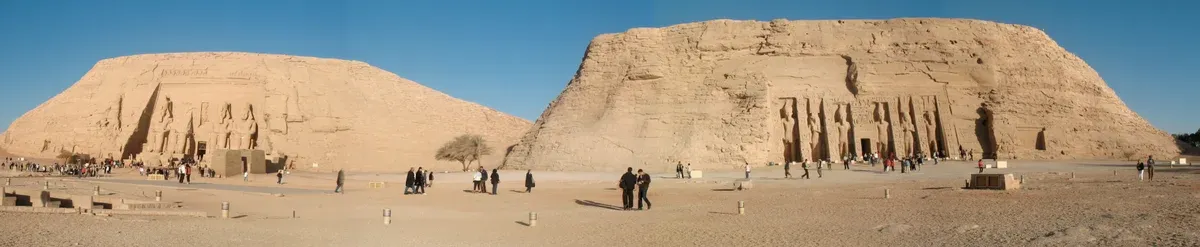
Both temples sit inside artificial mountains built after the move. Photo: Denise Chan, CC BY-SA 2.0, via Wikimedia Commons
Abu Simbel Relocation FAQ
What did Abu Simbel look like before the relocation?
The Great Temple stood 65 m lower and 208 m closer to the river. That ground is now under Lake Nasser water. For the visit today, see the abu simbel tours.
Where was the original location of Abu Simbel?
Lower and closer to the river, now under Lake Nasser water.
How long did the relocation take?
The work ran from 1964 to 1968, with the last block lifted on 16 April 1966 and the inauguration on 22 September 1968 with 500 guests. It finished 18 months ahead of schedule.
Can you visit Abu Simbel from Aswan in one day?
Yes. The shared Aswan day trip takes 10 hours and costs $40 per person. The site is about 300 km south of Aswan.
More Guides
- Abu Simbel Facts: Who Built It, When and Why?
Abu Simbel facts 2027: 2 temples, 4 colossi, built c. 1264 BC and moved in 1968. Know what to look for, then pick a day tour from Aswan.
- Temple of Nefertari at Abu Simbel: What Is Inside the Small Temple?
Temple of Nefertari 2027: 6 facade statues, 6 Hathor pillars, open 06:00-17:00. See what is inside the Small Temple and how to visit.
- Abu Simbel Hotels: Should You Stay the Night by the Temples?
Abu Simbel hotels from 2 to 5 stars, 2 shows a night and a day-trip comparison. See which night fits your trip 2027.