 Abu Simbel Egypt Tours
Home › Guides › Abu Simbel Facts: Who Built It, When and Why?
Abu Simbel Facts: Who Built It, When and Why?
These Abu Simbel facts start with a correction: the temples were cut for Ramesses II around 1264 BC, not 2400 BC as some pages claim, and they no longer stand where he built them. Two temples, four colossal statues and a sun alignment on 22 February and 22 October make it the best-known site in Nubia, and the abu simbel tours from Aswan reach it in one day.
Quick answer The facts that matter before you visit
Ramesses II had the Great Temple of Abu Simbel cut into the rock around 1264 BC, with a Small Temple for Queen Nefertari beside it. The temples were moved in 1964-1968 and the site is open 06:00 to 17:00 every day.
Key takeaways
- Two temples stand here, and the abu simbel tours from Aswan visit both.
- A foreign adult pays EGP 750 at the gate, and the group tour with a guide costs $65 per person with the entrance fee and an English-speaking guide included.
- The sun enters the sanctuary only on 22 February and 22 October, and the ticket rises on both dates.
- For a private day, the private day trip from Aswan costs $145 per person and includes entry fees and lunch.
What is so special about Abu Simbel?
It is a pair of rock temples with colossal statues, a sun alignment that works twice a year and a rescue that moved the whole site.
Three things set Abu Simbel apart from other Egyptian temples. Each one has a visit consequence. How the temples were moved is on Abu Simbel relocation, and the sun alignment on Abu Simbel Sun Festival.
The three reasons
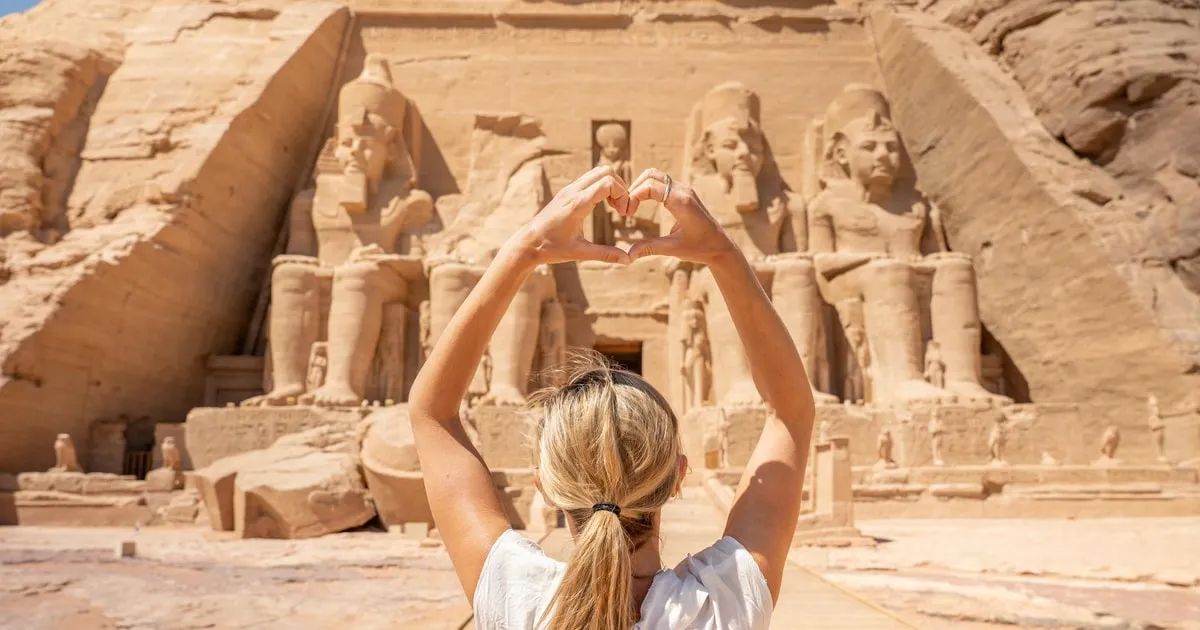
The first is the facade. Four seated colossi dominate the Great Temple, and all four show Ramesses II. They are about 20 m (66 ft) high on Britannica Kids' figure.
The second is the sun. On 22 February and 22 October the rays enter the temple, cross the main hall and light the innermost statues.
The third is the move. The Aswan High Dam threatened to flood the site, so an international effort led by UNESCO moved both temples in 1964-1968. The full story is on the relocation page.
To see all three in one day, compare the abu simbel tours.
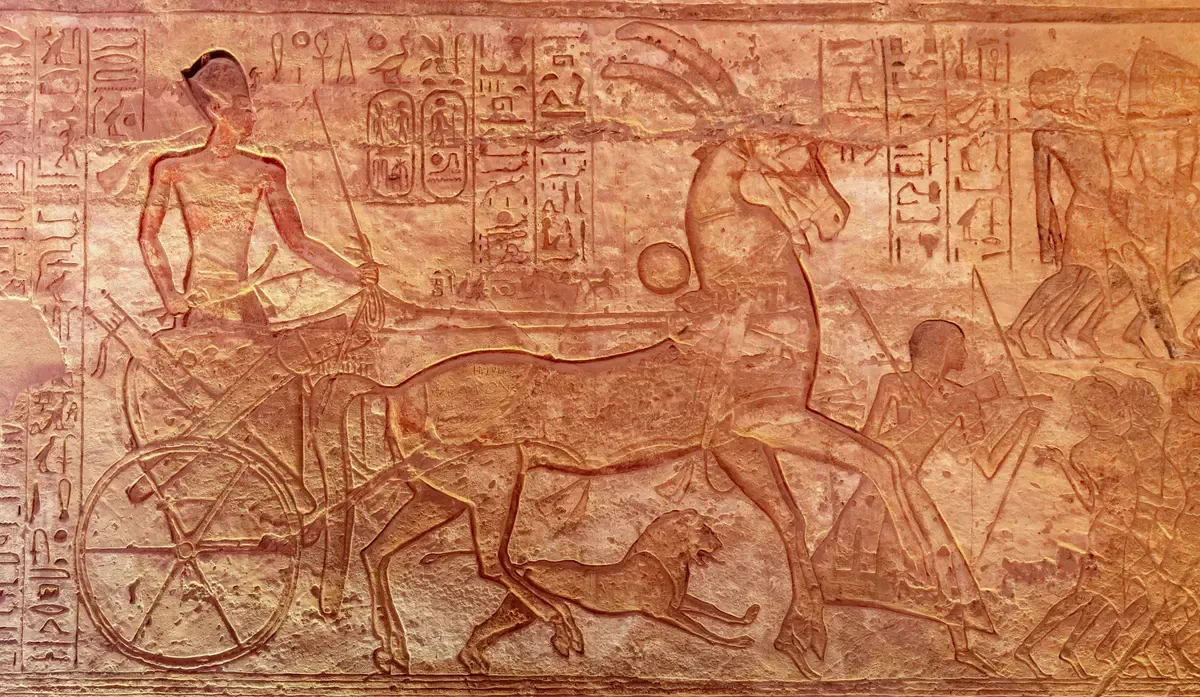
The Battle of Kadesh relief on the south wall of the hypostyle hall. Photo: Diego Delso, CC BY-SA 4.0, via Wikimedia Commons
What are 10 interesting facts about Abu Simbel?
Ten facts cover the builder, the date, the two temples, the statues, the sun, the move, Nefertari, UNESCO and the location.
Each fact comes with what to look for on the day.
The ten facts
1. Builder and date. Ramesses II of the Nineteenth Dynasty had the Great Temple cut around 1264 BC. Wikipedia gives c. 1264 BC to 1244 BC, about 20 years of work.
2. Two temples. The Great Temple is called the Temple of Ramesses, Beloved by Amun. The Small Temple to the north is dedicated to Hathor and Queen Nefertari.
3. Four colossi. The seated statues of the king dominate the facade. One collapsed in an ancient earthquake and its pieces lie at its feet.
4. Size. The statues at the Great Temple are about 66 ft (20 m) high. At the Small Temple they are about 35 ft (10.5 m).
5. The sun. On 22 February and 22 October the sun reaches Amun, Ra-Horakhty and the deified Ramesses. Ptah stays in shadow.
6. The move. The temples were relocated in 1964-1968, about 65 m higher and 200 m further inland. They were inaugurated on 22 September 1968.
7. Equal queen. Nefertari's colossi on the Small Temple match the king's in size. The ministry calls this a very rare example.
8. Cost. The relocation used 1,036 blocks (807 and 235).
9. World Heritage. Abu Simbel was listed by UNESCO in 1979 as part of the Nubian Monuments from Abu Simbel to Philae.
10. Location. Wikipedia places it on the western bank of Lake Nasser about 230 km southwest of Aswan and about 300 km by road.
| Fact | What to look for |
|---|---|
| Four colossi | The collapsed statue left of the entrance |
| Sun alignment | The innermost statues on 22 February or 22 October |
| Small Temple | The queen's statues at the same size as the king's |
| Relocation | The artificial hill behind the facade |
Sources: Egypt Tourism and Antiquities Ministry, Egypt Tourism and Antiquities Ministry.
Tours That Fit
Both leave from Aswan with hotel pickup. The group tour joins the daily convoy and the private trip leaves at 8:00 am.
 from $65
Ticket included
From Aswan: Abu Simbel Group Tour with Guide & Entrance Fees
Shared convoy trip at $65 with hotel pickup, guide and Abu Simbel entrance fee all included.
Check Availability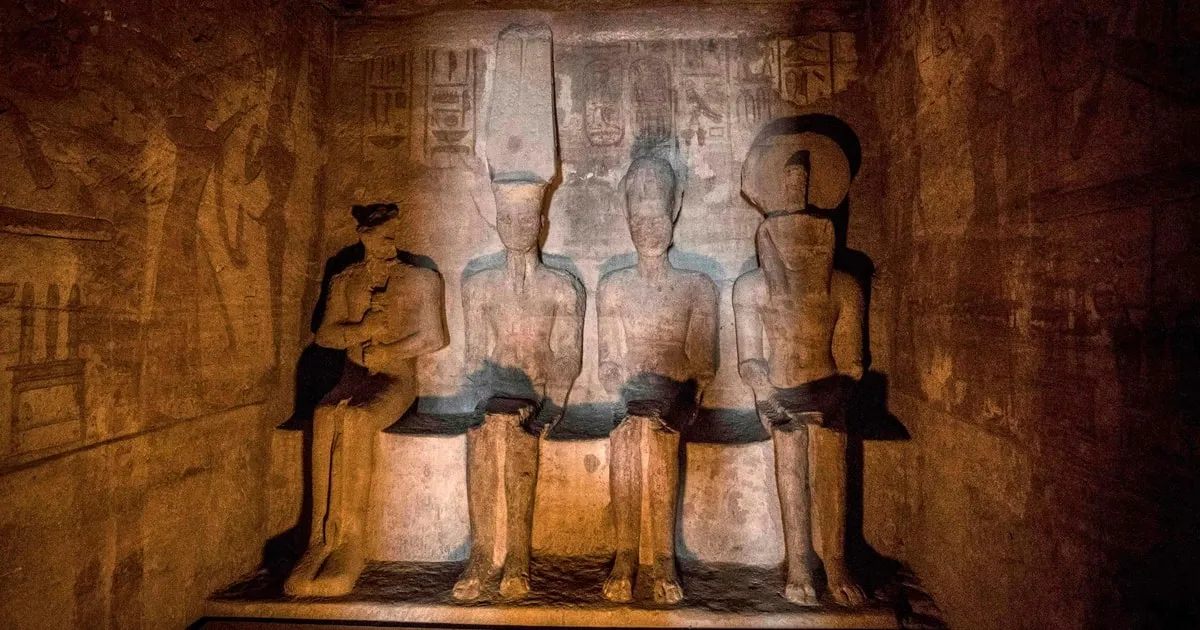 from $145
Best Private Day Trip To Abu Simbel From Aswan
Private 8:00 am departure with entry fees, lunch and water included at $145 per person.
Check AvailabilityWas Abu Simbel built in 2400 BC?
No, the Great Temple dates to about 1264 BC and took about 20 years.
One operator page prints 2400 BC. The ministry and Wikipedia give a much later date.
The sourced date
Egypt's tourism ministry says Ramesses II had the Great Temple cut into the living rock around 1264 BC. Wikipedia gives c. 1264 BC to 1244 BC. Ramesses came to Abu Simbel with his wife in year 24 of his reign.
The same operator page also claims the site survived a 10-magnitude earthquake. That claim has no source. What is documented is that the statue left of the entrance fell in an earthquake in antiquity.
Ancient graffiti
Later visitors left their mark too. Greek and Carian mercenaries of Psamtik II scratched their names on the colossus. Ask your guide to point the graffiti out.
Is Abu Simbel one temple or two?
Two: the Great Temple of Ramesses II and the Small Temple of Hathor and Nefertari.
The Small Temple is easy to miss on a rushed stop. It stands to the north of the Great Temple.
Great Temple
The group tour visits both temples with a guide, and the private day trip lists 2 hours at Abu Simbel, 2 hours at the Temple of Ramesses II and 1 hour at the Temple of Nefertari. The main temple has three halls dedicated to sun gods. The hypostyle hall is 18 m long and 16.7 m wide with eight Osirid pillars.
Reliefs record the Battle of Kadesh.
Small Temple
The Small Temple is dedicated to the goddess Hathor and Queen Nefertari. Nefertari's colossi are the same size as the king's. The interior has its own page on the Temple of Nefertari.
Does the sun light all four statues in the sanctuary?
No, it lights three of the four and leaves Ptah in shadow.
The alignment is the best-known fact about the site.
Which statues and which dates
On 22 February and 22 October the sun reaches Amun, Ra-Horakhty and the deified Ramesses. Ptah stays dark. On 22 Feb 1966 the team confirmed the light reached the sanctuary 63.1 m in. One operator says 200 m while other pages say 60-63 m, so treat the longer figure with caution.
On both dates the foreign adult ticket rises to EGP 1,200 and the student ticket to EGP 600. On other days they pay EGP 750 and EGP 375.
| Ticket | Normal day | 22 Feb and 22 Oct |
|---|---|---|
| Foreign adult | EGP 750 | EGP 1,200 |
| Foreign student | EGP 375 | EGP 600 |
| Egyptian adult | EGP 30 | EGP 60 |
| Egyptian student | EGP 10 | EGP 20 |
When was Abu Simbel rediscovered?
The Swiss researcher Johann Ludwig Burckhardt found it in March 1813.
The outside world did not know the temples until 1813.
Burckhardt and Belzoni
Burckhardt found the site in March 1813. Belzoni entered the Great Temple on 1 August 1817.
In the 1960s the temples were cut into blocks and rebuilt on higher ground. The relocation page gives the figures.
What do you need to know before you visit Abu Simbel?
The site is open 06:00 to 17:00 every day, about 300 km south of Aswan, with a foreign adult ticket of EGP 750.
The practical facts, in one table.
Visit facts
The ministry puts Abu Simbel about 300 km south of Aswan. The Sound and Light company says 280 km. The UK FCDO advises against all but essential travel west of the Nile Valley, but names Abu Simbel among the exceptions.
The Sound and Light show runs at 19:00 and 20:00 daily.
| What | Fact |
|---|---|
| Hours | 06:00-17:00 every day |
| Foreign adult | EGP 750 |
| Foreign student | EGP 375 |
| Distance from Aswan | About 300 km |
| Airport | Built 1969 with one 2,000 m runway |
| Day trip from Aswan | $65 per person on the group tour with the entrance fee included, or $145 on the private day trip with entry fees and lunch included |
Sources: Egypt Tourism and Antiquities Ministry, Egypt Tourism and Antiquities Ministry, Sound and Light Egypt.
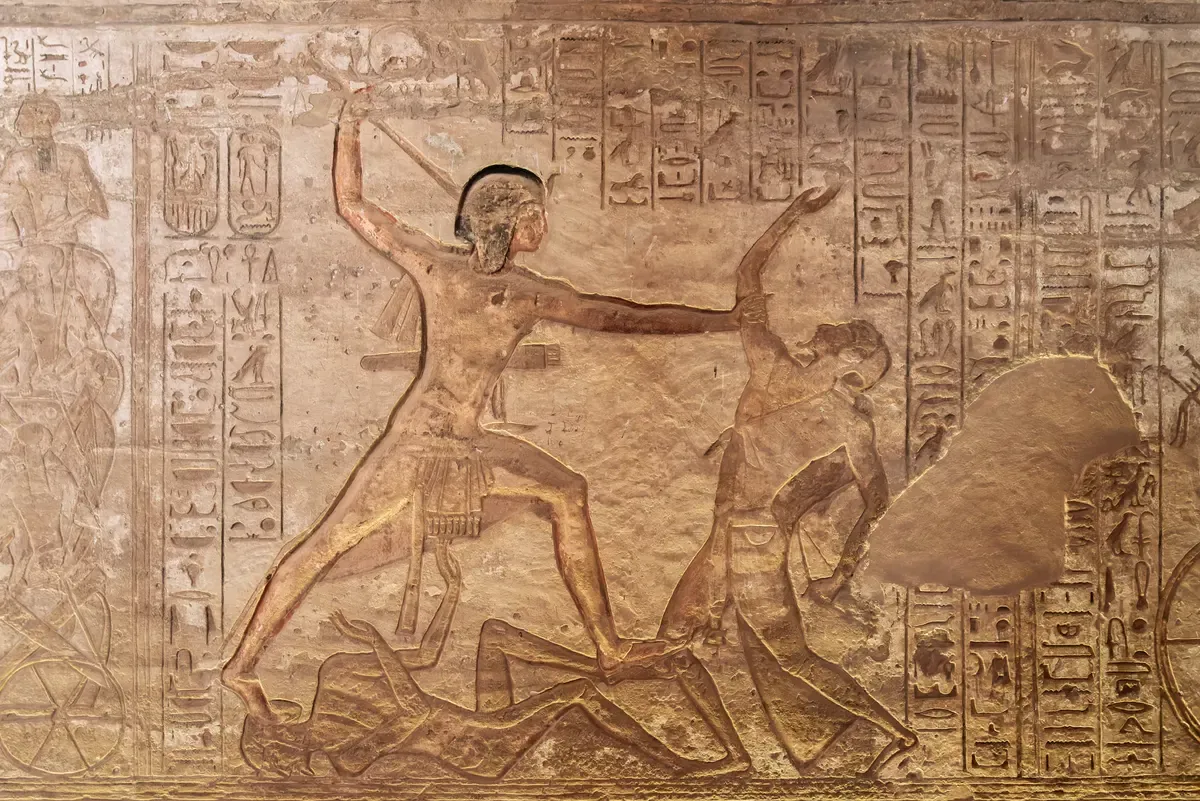
Ramesses II shown slaying enemies in the Great Temple reliefs. Photo: Mustang Joe, CC0, via Wikimedia Commons
Abu Simbel Facts FAQ
What are 10 interesting facts about Egypt?
This page covers Abu Simbel. For Egypt more widely, the ministry lists ten Nubian sites from Abu Simbel to Philae as World Heritage, Aswan was called Sunn by the ancient Egyptians and Edfu and Kom Ombo temples lie north of Aswan. See the abu simbel tours for a Nubia day trip.
Are Abu Simbel facts for kids different?
The figures are the same. Britannica Kids gives the Great Temple statues as about 66 ft (20 m) and the Small Temple statues as about 35 ft (10.5 m).
Is Abu Simbel underwater?
The original site is now under Lake Nasser water. The temples were moved to higher ground in 1964-1968, so the visit is dry. The relocation page has the figures.
Who is Nefertari?
She was the queen the Small Temple honours with Hathor. The Temple of Nefertari page has the details, and the abu simbel tours visit both temples.
How far is Abu Simbel from Aswan?
About 300 km on the ministry's figure. The group day tour from Aswan takes 10 hours and the private trip takes 9 hours, with about 3 hours of driving each way.
More Guides
- Abu Simbel Relocation: How and Why Were the Temples Moved?
Abu Simbel relocation 2027: 1,036 blocks cut and rebuilt 65 m higher in 1964-1968. See how it was done and what to look for on site.
- Temple of Nefertari at Abu Simbel: What Is Inside the Small Temple?
Temple of Nefertari 2027: 6 facade statues, 6 Hathor pillars, open 06:00-17:00. See what is inside the Small Temple and how to visit.
- Abu Simbel Sun Festival 2027: When Does the Sun Reach the Sanctuary?
Abu Simbel Sun Festival 2027 on 22 February and 22 October: what happens, the EGP 1,200 ticket and tours from Aswan. Plan it.